Why We Should Walk (More)
Walking more improves not just physical health but helps to process emotions and brings mental clarity. In comparison to cycling or faster means of transportation, it forces the walker to slow down and notice surroundings. This quiet, constant movement helps to think through and gently release what has accumulated in the mind and body in a way that faster travel or screen time doesn’t allow.
There could be two versions of this article: one that gives you numbers, such as steps per day, calories burnt, and scientific studies on cardiovascular health. These aspects certainly stand their ground; however, I personally prefer the less obvious reasons, the version that argues that walking is one of the last things left to us human beings that asks nothing of us but time.
In comparison to running, it needn’t require much endurance or strong fitness. In terms of presence, it allows for plenty of daydreaming, letting the mind drift with the clouds or get lost in the horizon. In terms of money, it’s one of the last resources that is still free, and the air we breath hasn’t been taxed (yet—polluted, yes—but that’s another topic).
Walking doesn't need to be learnt nor earned
Most of what we do today has to justify itself. It needs an outcome, a metric, a reason it was worth the hour. I think walking genuinely resists that. Usually we don't walk to arrive somewhere faster, because there are better ways to do that. We walk because the walking itself is the point, which is a strange thing to do in a world built around optimisation and efficiency. Therefore to me, it is a quietly rebellious act to do in a frenetic world.
The German philosopher Immanuel Kant (1724-1804) understood this instinctively, probably long before optimisation was a word anyone used. Every afternoon he would walk the same route through Königsberg at almost the exact same hour, for years. In fact, the story goes that he was so precisely on time that his neighbours set their clocks by him. His walk wasn't a means to anything. It was the shape his thinking took. And similar stories can be told of many other philosophers and writers as well.
When we walk, we aren’t accumulating anything—no follower, no purchase, no proof. Just a body moving through a place, at the natural speed our body can actually follow. That's it. And for a lot of us, I permit myself to say, that nothingness might be exactly what many are starving for.
Doing gloriously nothing
That same instinct against accumulation shows up in how overstimulated our brains have become. Everything we perceive, think, feel, do, and learn is like food to the brain, and this intake rarely stops or slows down. Watching a film, listening to a podcast or music, or doom scrolling has become a widely accepted way to relax. Unfortunately, though, most people don’t realise that consuming more media—basically feeding the brain with even more information—isn’t relaxing for it at all. Think of it this way: every stimulus that enters the brain is a small jolt of activity. String enough of these together, and it soon becomes a cobweb of chaos or traffic jam. The brain never gets a pause. Rest for the brain and nervous system actually requires no intake, no content, just some time of doing gloriously nothing, letting the organism process what it has already taken in.
It simply puts us back in scale
In his book Unverfügbarkeit (2018, p.12) the German sociologist Hartmut Rosa (1965-) asserts that “Acceleration turns the world into a place of aggressiveness, where one seeks to seize the world rather than to receive it.”
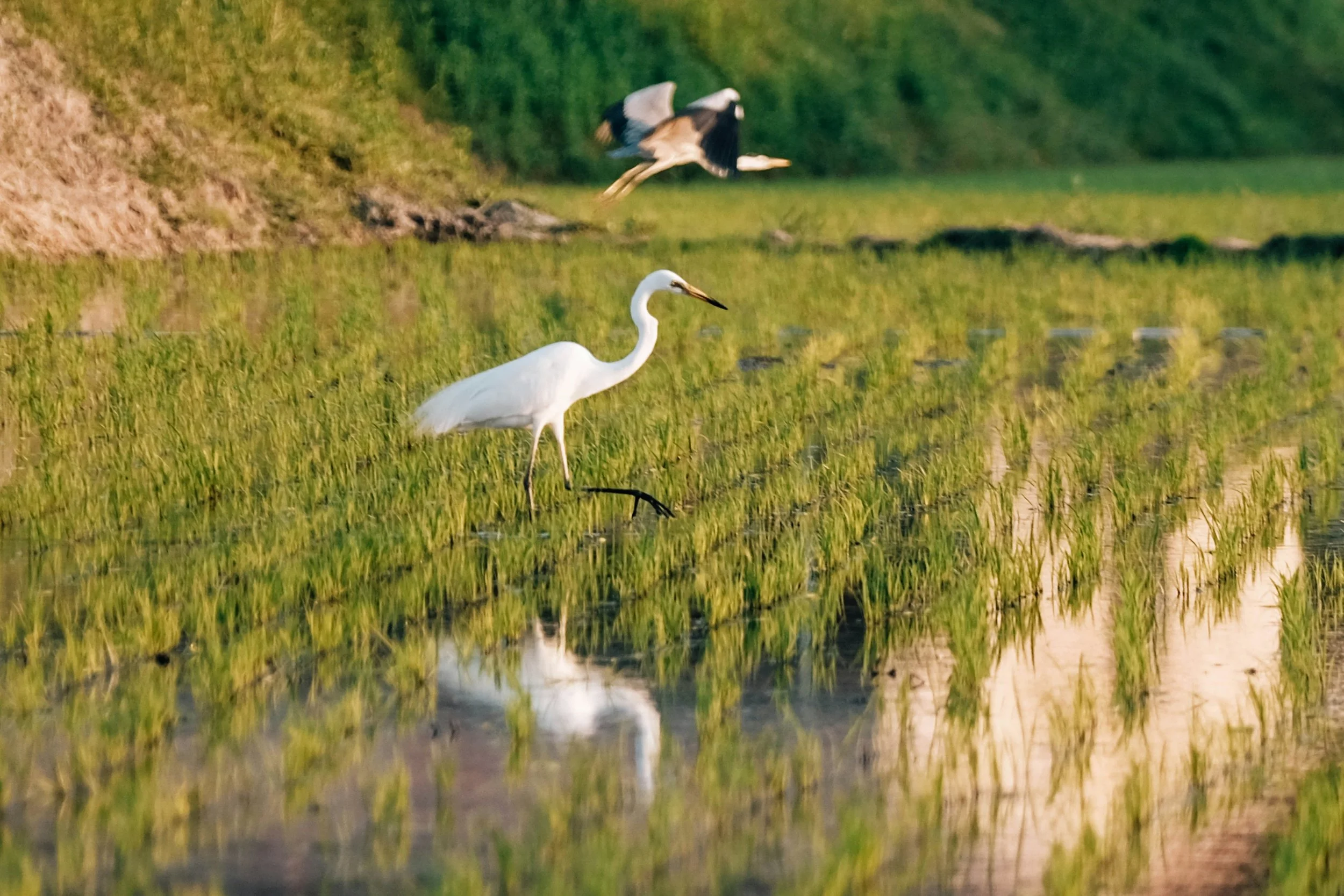
Put differently, walking holds the power to put us human beings back into human scale. While a car ride past a rice field turns to a blur, a walk past the same rice field allows curiosity to rise and awe to unfold. A rice field suddenly becomes a composition of a hundred small things: a crane catching a frog for lunch, or rice grass in bloom. Perhaps the sound underfoot changes from gravel to soil, or one is given an acknowledging nod from a rice farmer while passing. Walking ought to be the only speed at which a place might actually reveal its magic to us, even if just for a blink of an eye.
I think that is exactly why it can quieten the thoughts, dampen doubts or undo undesireable feelings. It puts us back into relationship with our surroundings and brings us back to a humbler, more human, size. Somewhere between kilometre 8 and kilometre 80, most people stop being able to keep performing. The stories we tell about ourselves, or to ourselves, get harder to maintain when our feet hurt and there are still more kilometres to go. What's left, underneath that, tends to be more honest.
Friedrich Nietzsche (1844-1900), a fond cultural critic, put it more bluntly than most: only thoughts reached by walking have any value. He wrote much of his later work on foot, in the mountains above Sils-Maria in Switzerland, distrusting anything he'd worked out sitting down. The Swiss philosopher Jean-Jacques Rousseau (1712-1778) went further still and claimed he could barely think at all indoors, that his mind only started moving once his legs did.
Walking as a way of processing
Long before therapy had a name, people walked things off: grief, pride, or the sense that something in life needed to change but they didn't yet know what. There's a reason pilgrimage exists in nearly every culture, and I don’t think that’s incidental. The destination was rarely the point. The walking just did something sitting still couldn’t.
Another well known philosopher, often troubled by his own mind, Søren Kierkegaard (1813-1855), wrestled intensely with depression and guilt, feelings that didn’t resolve by thinking harder. He walked the streets of Copenhagen daily and wrote in Letters & Documents:
“Above all, do not lose your desire to walk. Everyday, I walk myself into a state of well-being and walk away from every illness. I have walked myself into my best thoughts, and I know of no thought so burdensome that one cannot walk away from it. But by sitting still, and the more one sits still, the closer one comes to feeling ill. Thus if one just keeps on walking, everything will be all right.”
Long story short, we don't need a 1,200-kilometre trail for this. From personal experience, I’d say a daily walk, without distraction, no screen, no music, without a destination that matters more than the walk itself, is plenty. There are quite lustrous discoveries made when the mind doesn’t have to perform and one simply begins observing.
No distance, no hurry, no reason needed to walk
This isn't a call to sign up for an ironman. It's so much smaller than that, so much humbler, in fact. Just an hour without a podcast. A walk to the next village. A weekend on a trail with nothing to prove, nor be experienced for Instagram.
Contentment doesn't usually arrive where we’ve acquired something. More often, it gracefully shows up softly, a few kilometres in, when resting or noticing the environment—once we've finally stopped moving fast enough to outrun it.