Tapsa Temple: One Man, Thirty Years, and Eighty Stone Pagodas
Tapsa Temple is a unique Buddhist temple on Mount Maisan in Jinan County, South Korea. It is famous for its more than 80 hand-stacked, unusual stone towers, built without mortar by the Buddhist layman Lee Gap-ryeong over between 1885 to the early 1900s.
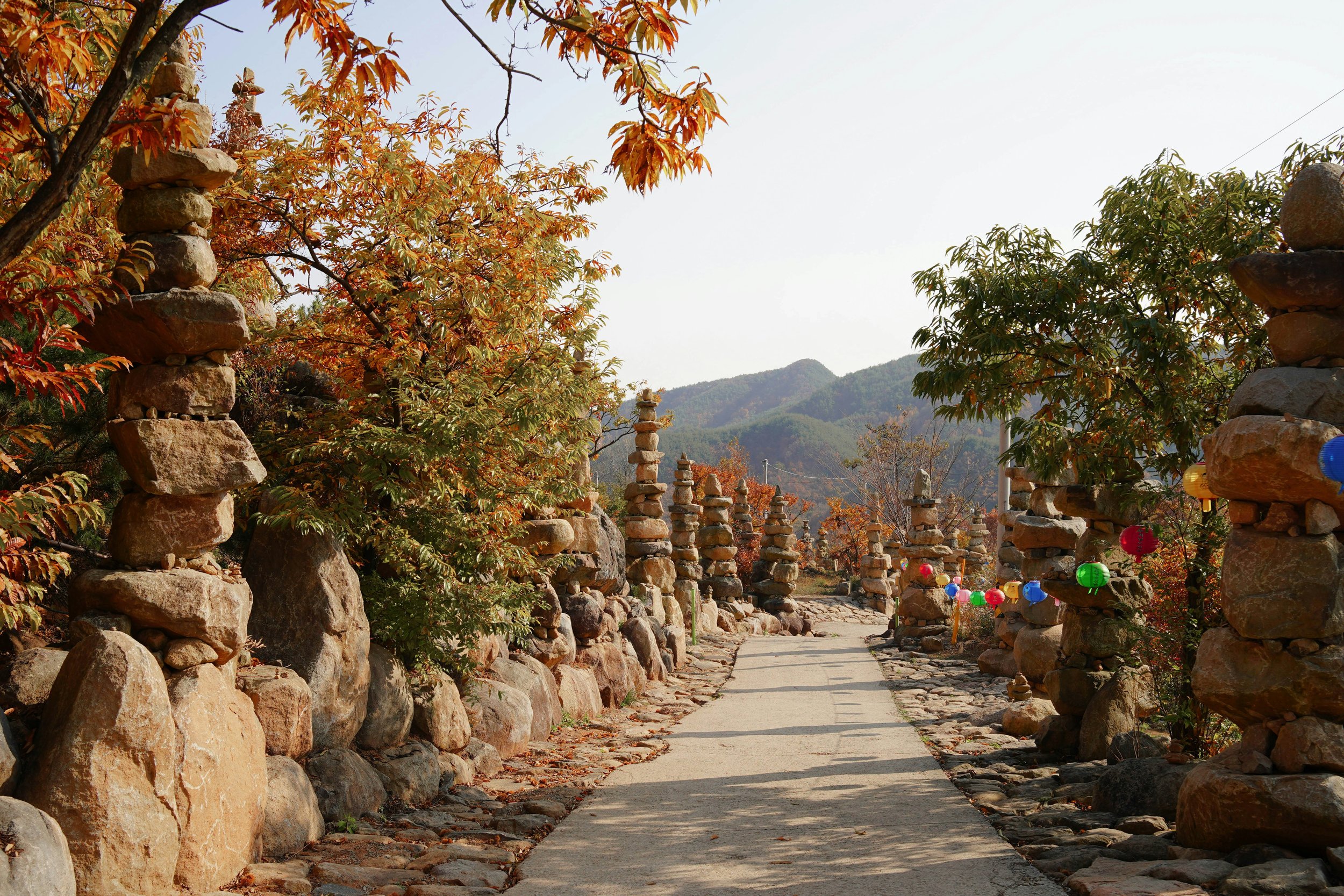
The man who built a mountain of prayers
Long before it was a destination, this was simply a mountain until a man came to it wondering about the restless nature of humankind. Tapsa’s story begins with a layman named Lee Gap- ryeong, who first arrived at Maisan in 1885, wen he was 25. (San in Korean means mountain, and mai means horse ear.) He hadn’t come to build a monument. He had come solely to meditate, to sit quietly among the mountains and listen to whatever they had to teach him.
What followed were 30 years of patient dedication, as he began stacking natural stones into conical towers, without mortar, without machinery, just one stone at a time. They are now referred to as pagodas. (To learn more about pagodas please read here. > put link)
He gathered smaller stones from nearby, and for the largest pagodas, carried material from streams and surrounding mountains. By some accounts he collected stones by day and stacked them by night.
Over 120 pagodas were build, of which around 80 remain today. They range from a single metre to over thirteen metres tall, in shapes from conical to arrow-straight. The two tallest, rising behind the main hall, are known as the Heaven and Earth towers. He never used mortar. And more than a century of wind, rain, and snow later, they are still standing.
Late in life, Lee Gap-ryeong was ordained as a monk. He died at Tapsa in 1957, close to a hundred years old, having spent most of his adult life doing one patient and repetitive action: placing a stone, waiting, placing another stone, then another and another.
Why it stays with me
I think about Tapsa often when I loose direction in my daily life. The hermit wasn’t thinking about efficieny or any long-term goal. He didn’t set off to build a temple, nor did he plan to build a fixed number of stone towers. Instead he was just stacking one stone upon another. That was enough. His actions became a prayer, filled with the purest of intention and mere dedication. And from this, something one might call conviction germinated and grew.
There was no talk of achievements or efficiency in what Lee Gap-ryeong did. He took no shortcuts, nor did he seek anyone’s permission or approval of any temple authority. He did what felt right to him. Just one person, one mountain, and thirty years of showing up. It makes me wonder, do we still live by these virues in our fast-paced lives? Doesn’t the freedom so many of us grow up with leave us—paradoxically—a little list?
Yet, Tapsa is still there. It endured because it was built slowly, by hand, with dedication.
I believe it’s that same quiet logic that draws people into doing a pilgrimage by foot. Walking is certainly not the fastest way to reach a destination, but all the noise inside and out, slowly, slowly—step by step, breath by breath—falls from one’s shoulders. I don’t know why people walk, but I have been told one recurring reason by pilgrims I met: a longing for clarity, or for a sense of one’s own capability.
In a modern world tormented by infinte demands, the path only asks that one put one foot in front of the other. One step at a time. One breath at a time. It asks for trust, because one often doesn’t know where one will end up, or what one might encounter, internally and externally, along the way.
In an unknown corner, the hermit Lee Gap-ryeong depicts the same magic in the rhythm of stacking stones. He build a mountain of appreciation and love where—to the eye—there had only been stones.
How do I get to Tapsa Temple?
Take a bus or a train from Seoul to Jeonju Station. It’s worth booking train tickets in advance, as trains tend to be sold out at short notice and seats are limited. From Jeonju, you have 2 options.
Ideally, take a direct bus from Jeonju Bus Terminal to Maisan Park, where sirectional signs lead you to the temple. As far as I’m aware three buses a day run from Jeonju to Maisan, and the last return bus should leave around 5pm. However, please double-check once you are there.
Alternatively, take a bus from Jeonju to Jinan-gun Bus Terminal, from where there should also be buses to Maisan, or take a taxi. Don’t bother with Kakao Taxi since Uber works just as well. It’s a gentle walk and there is a lake along the way.