Is the Dongseo Trail Open Yet? A 2026 Update
Korea's first coast-to-coast hiking route, the 849 km Dongseo Trail (동서트레일), is opening in stages. Here's exactly which sections you can walk right now, what's still under construction, and when the full trail is expected to open.
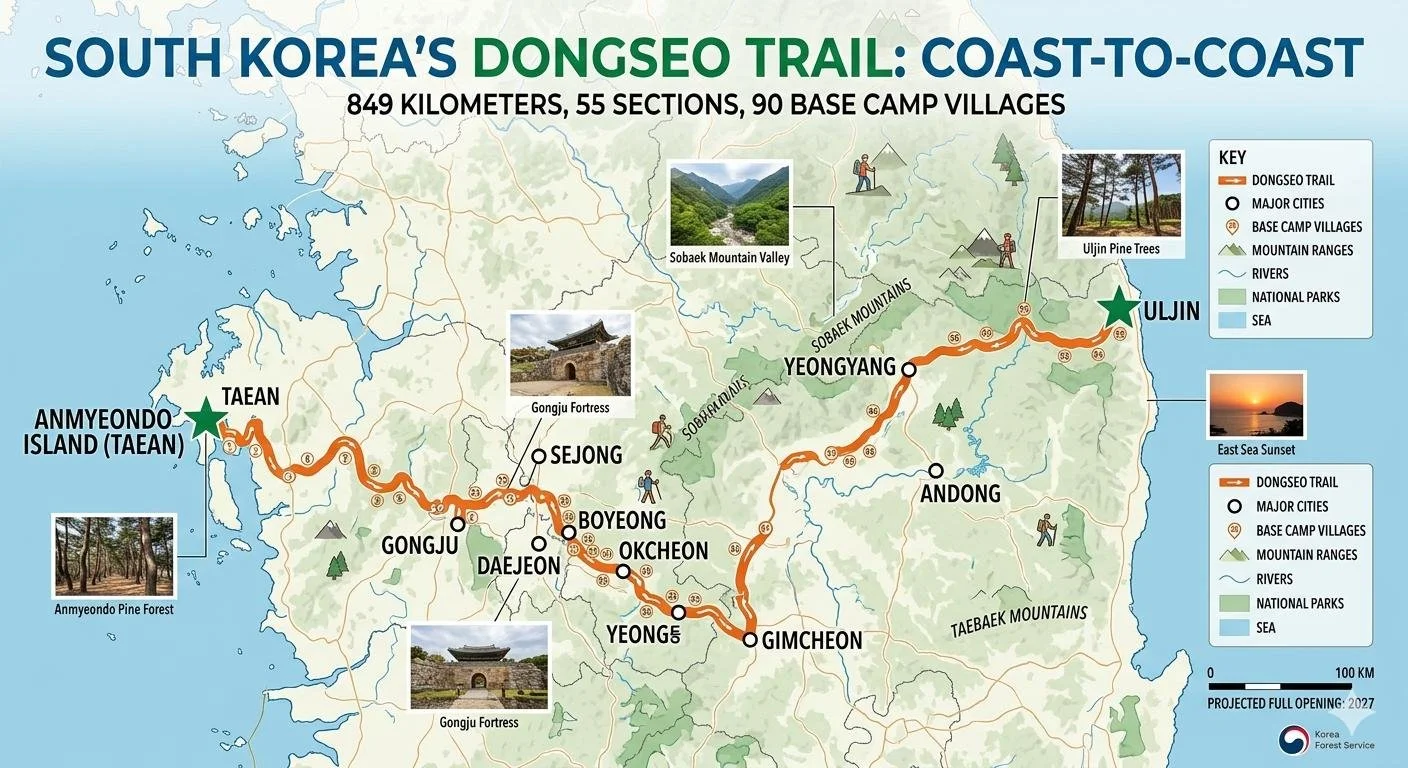
If you've been searching for the Dongseo Trail hoping to book a hike this year, the honest answer is: probably not yet, because the trail hasn’t been officially opened.
What the Dongseo Trail Is
The Dongseo Trail is Korea's first long-distance, coast-to-coast hiking route, stretching 849 km from Anmyeon Island on the west coast (Taean, South Chungcheong Province) to Uljin on the east coast (North Gyeongsang Province). It's often described as Korea's answer to the Camino de Santiago, and it’s quite different from traditional Korean hiking, which tends to be about summiting individual mountain peaks. Unlike a single-summit hike such as the Jirisan Ridge Hike, it’s a long walk through forests, coastline, passing Buddhist temples and small rural villages. The Korea Forest Service is building it in 55 main sections plus 9 branch routes.
What's Open Right Now
The trail is opening piece by piece rather than all at once. As of 2026:
The western starting sections in Taean (sections 1-4, roughly 57 km) have opened, beginning at Anmyeondo Island and running through pine forests and along Kkotji Beach.
Two eastern sections were opened in 2026 as well: section 55 in Uljin (about 20 km) and section 47 in Bonghwa (about 15 km).
Altogether, around 244 km across 17 sections have been opened on a pilot basis, spread across different parts of the route rather than one continuous stretch.
So you can walk real, waymarked pieces of the Dongseo Trail today but the whole Dongseo trail from west to east cannot yet be walk from end to end.
When Will It Fully Open?
Construction on the remaining sections is expected to wrap up by 2027, with the full 849 km route officially opening to the public that year. Again inspired by the infratructure of the Camino, the Korea Forest Service is also building out 90 "base camps" at small villages and 44 campsites along the way, so future hikers will be able to rest, eat, and sleep in small local communities rather than carrying everything with them. This is intended to stimulate the local economy, and it dovetails with Korea’s political aim of repopulating smaller rural towns.
It’s worth knowing that for wildlife protection wild camping is not permitted in Korea—camping outside official campsites simply isn’t acceptable. This is precisely why the Korea Forest Service has been developing these designated campsites and specialised shelters. As a guest in a foreign country, please respect local customs rather than assuming home rules apply. The problem isn’t only that it will land you in trouble, it also reflecty badly on tourists more broadly.
Should You Walk It Now, Or Wait?
If you want a shorter, quieter walk through some genuinely beautiful and lesser-known corners of Korea, the opened sections—especially the Taean coastal stretch or the over 500-years old Uljin Pine Forest—are already worth it. If your goal is the full coast-to-coast crossing in one single go, which should take about 4-5 weeks, better wait until 2027 or 2028. All in all, it can be a more ecological and respectful way of travelling.
Either way, this is a trail still being written into existence. Walking it early means walking it before the crowds arrive.
In 2027, Wild Pilgrim will probably offer its first guided tour on the Dongseo trail. If you want to be among the first to be invited, sign up to the waiting list.